Tutorial de jms
https://drive.google.com/open?id=0B8fTeB-2yen7YWwtSnFEbUJLaDA
lunes, 20 de febrero de 2017

Distributed Objects
Component Object Model (COM) is a binary-interface standard for software components introduced by Microsoft in 1993. It is used to enable inter-process communication and dynamic object creation in a large range of programming languages. COM is the basis for several other Microsoft technologies and frameworks, including OLE, OLE Automation, Browser Helper Object, ActiveX, COM+, DCOM, the Windows shell, DirectX, UMDF and Windows Runtime. The essence of COM is a language-neutral way of implementing objects that can be used in environments different from the one in which they were created, even across machine boundaries. For well-authored components, COM allows reuse of objects with no knowledge of their internal implementation, as it forces component implementers to provide well-defined interfaces that are separated from the implementation. The different allocation semantics of languages are accommodated by making objects responsible for their own creation and destruction through reference-counting. Type conversion casting between different interfaces of an object is achieved through the
QueryInterfacemethod. The preferred method of "inheritance" within COM is the creation of sub-objects to which method "calls" are delegated.Video:
https://www.youtube.com/watch?v=-uodiz25YNE&list=PLbgCut2PkQHlzbxldE6F8fMYgqS4dxG9d
miércoles, 15 de febrero de 2017
JMS
What Is Messaging?
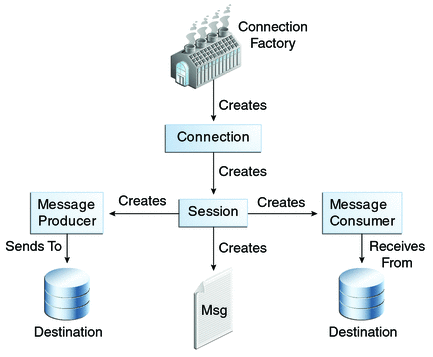
Messaging is a method of communication between software components or applications. A messaging system is a peer-to-peer facility: A messaging client can send messages to, and receive messages from, any other client. Each client connects to a messaging agent that provides facilities for creating, sending, receiving, and reading messages.
Messaging enables distributed communication that is loosely coupled. A component sends a message to a destination, and the recipient can retrieve the message from the destination. However, the sender and the receiver do not have to be available at the same time in order to communicate. In fact, the sender does not need to know anything about the receiver; nor does the receiver need to know anything about the sender. The sender and the receiver need to know only which message format and which destination to use. In this respect, messaging differs from tightly coupled technologies, such as Remote Method Invocation (RMI), which require an application to know a remote application’s methods.
Messaging also differs from electronic mail (email), which is a method of communication between people or between software applications and people. Messaging is used for communication between software applications or software components.
What Is the JMS API?
The Java Message Service is a Java API that allows applications to create, send, receive, and read messages. Designed by Sun and several partner companies, the JMS API defines a common set of interfaces and associated semantics that allow programs written in the Java programming language to communicate with other messaging implementations.
The JMS API minimizes the set of concepts a programmer must learn in order to use messaging products but provides enough features to support sophisticated messaging applications. It also strives to maximize the portability of JMS applications across JMS providers in the same messaging domain.
The JMS API enables communication that is not only loosely coupled but also:
- Asynchronous: A JMS provider can deliver messages to a client as they arrive; a client does not have to request messages in order to receive them.
- Reliable: The JMS API can ensure that a message is delivered once and only once. Lower levels of reliability are available for applications that can afford to miss messages or to receive duplicate messages.
The current version of the JMS specification is Version 1.1. You can download a copy of the specification from the JMS web site: http://www.oracle.com/technetwork/java/index-jsp-142945.html.
When Can You Use the JMS API?
An enterprise application provider is likely to choose a messaging API over a tightly coupled API, such as a remote procedure call (RPC), under the following circumstances.
- The provider wants the components not to depend on information about other components’ interfaces, so components can be easily replaced.
- The provider wants the application to run whether or not all components are up and running simultaneously.
- The application business model allows a component to send information to another and to continue to operate without receiving an immediate response.
For example, components of an enterprise application for an automobile manufacturer can use the JMS API in situations like these:
- The inventory component can send a message to the factory component when the inventory level for a product goes below a certain level so the factory can make more cars.
- The factory component can send a message to the parts components so the factory can assemble the parts it needs.
- The parts components in turn can send messages to their own inventory and order components to update their inventories and to order new parts from suppliers.
- Both the factory and the parts components can send messages to the accounting component to update budget numbers.
- The business can publish updated catalog items to its sales force.
miércoles, 8 de febrero de 2017
Welcome to the jungle
Ligas a material.
Tutorial de android
Presentación de RPC
Ejemplo de RPC
Ejemplo RMI
Presentación para RMI
IP y multicast
Material
Tutorial de android
Presentación de RPC
Ejemplo de RPC
Ejemplo RMI
Presentación para RMI
IP y multicast
Material
Suscribirse a:
Comentarios (Atom)